
The anticipation has been building for months, and now, Qualcomm’s next-generation Snapdragon 8 Gen 4 processor is finally making waves. Officially set to launch in October, this chip promises to redefine what we can expect from mobile performance. We’ve been hearing rumors and seeing leaks, but now, concrete details are starting to emerge, and they paint an exciting picture of the future of mobile technology.
Benchmarking Brilliance
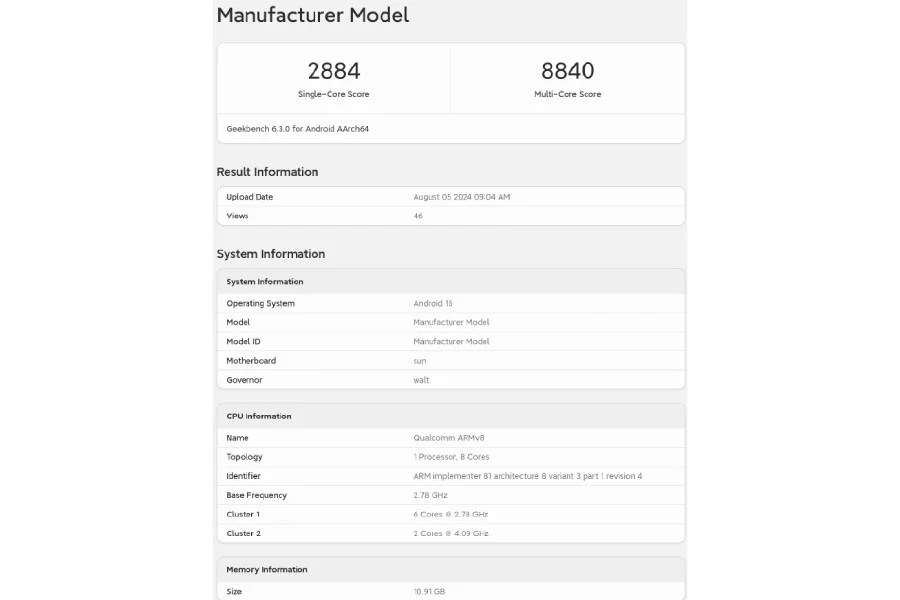
The Snapdragon 8 Gen 4 has recently appeared on the Geekbench platform, giving us a tantalizing glimpse into its capabilities. While the listing is labeled as a “Manufacturer Model,” indicating it might not be the final production version, the scores are nothing short of impressive. In the single-core test, the Snapdragon 8 Gen 4 scored 2884 points. This puts it in close competition with Apple’s A17 Pro, which averages around 2915 points. But it’s in the multi-core performance where the Snapdragon 8 Gen 4 truly shines, scoring a whopping 8840 points, significantly surpassing the A17 Pro’s average of about 7300 points.
A Custom Core for a New Generation
One of the most significant changes Qualcomm is bringing with the Snapdragon 8 Gen 4 is the adoption of a new architecture. Moving away from the standard Arm cores, the chip will feature a custom Oryon CPU design. This is the same approach Qualcomm used in their Snapdragon X-series for PCs, and it’s expected to provide a substantial performance boost. The early Geekbench results certainly suggest that Qualcomm is on the right track with this new design.
The benchmark details also reveal an octa-core structure, consisting of six base cores clocked at 2.78GHz and two high-performance cores running at an impressive 4.09GHz. This combination is poised to deliver exceptional performance across a range of tasks, from everyday use to intensive gaming and multitasking.
Price and Availability
Of course, all this advancement comes at a cost. According to analyst Ming-Chi Kuo, the Snapdragon 8 Gen 4 will be 25-30% more expensive than its predecessor, the Snapdragon 8 Gen 3. This price hike is likely to translate into higher costs for flagship smartphones in 2025. While this might be a concern for budget-conscious consumers, the improved performance and efficiency might justify the additional expense for many.
Gaming and Efficiency
The Snapdragon 8 Gen 4 is also set to impress in the gaming arena. According to a report from MyDrivers, the chip, which might launch at the Snapdragon Summit on October 21, will feature an improved gaming performance, support for LPDDR6 RAM, and an updated Neural Processing Unit (NPU). The prime core is expected to be clocked at 4.2 GHz, a significant leap from the 3.4 GHz peak clock speed of the Snapdragon 8 Gen 3.
However, there are some conflicting reports about its GPU performance. While some sources claim it will surpass Apple’s A17 Pro in processing power, a user on X (formerly Twitter), @negativeonehero, suggested that its peak GPU performance might be less than the A17 Pro and similar to MediaTek’s Dimensity 9300. They also mentioned that the CPU performance might only see a “single-digit” improvement. Despite these mixed predictions, one thing seems certain: the Snapdragon 8 Gen 4 is expected to be more power-efficient, reportedly consuming only 8W during the multi-core benchmark.
Looking Ahead
With its official launch just around the corner, the Snapdragon 8 Gen 4 is shaping up to be a game-changer in the mobile processor market. Its impressive benchmark scores, custom Oryon CPU design, and potential for enhanced gaming performance are set to make it a standout choice for next-generation flagship smartphones. While the higher cost may be a consideration, the advancements in performance and efficiency are likely to make it a worthwhile investment for many users.



 OnlineFuss
Leave a comment